
For Directors of Clinical Governance and Quality
Accreditation evidence
from routine clinical care.
Clinical decisions guided by your own procedures, recorded at the point of care and mapped to the standards you report against.
See the standards and evidence mapping.
A quality improvement cycle, benchmarked against peers, that records its own accreditation evidence.
The challenges
- Governance teams work to a three-year NSQHS cycle, assemble sampled audits manually before each survey, and after an incident must establish what the guidance said at the time.Governance teams work to an Accreditation Canada cycle, assemble sampled audits manually before each survey, and after an incident must establish what the guidance said at the time.
- Staff are often unclear which resource to follow. Resources can give conflicting recommendations, or be unclear on how to manage particular scenarios.
- A clear local procedure, once written, is rarely accessed. Given the volume of clinical information reaching frontline staff, each procedure change needs a large education campaign to raise awareness.
Capabilities for clinical governance
01 · ACCREDITATION EVIDENCE
Evidence captured from routine clinical use
Decisions, audits and hint responses are mapped to Standard 1 (1.27 evidence-based care, 1.28 variation), Standard 3 (3.18 and 3.19) and Standard 4 medication safety actions. The mapping is published for review ahead of each survey.Decisions, audits and hint responses become the evidence for your antimicrobial stewardship and medication safety Required Organizational Practices, captured during routine care rather than sampled retrospectively.
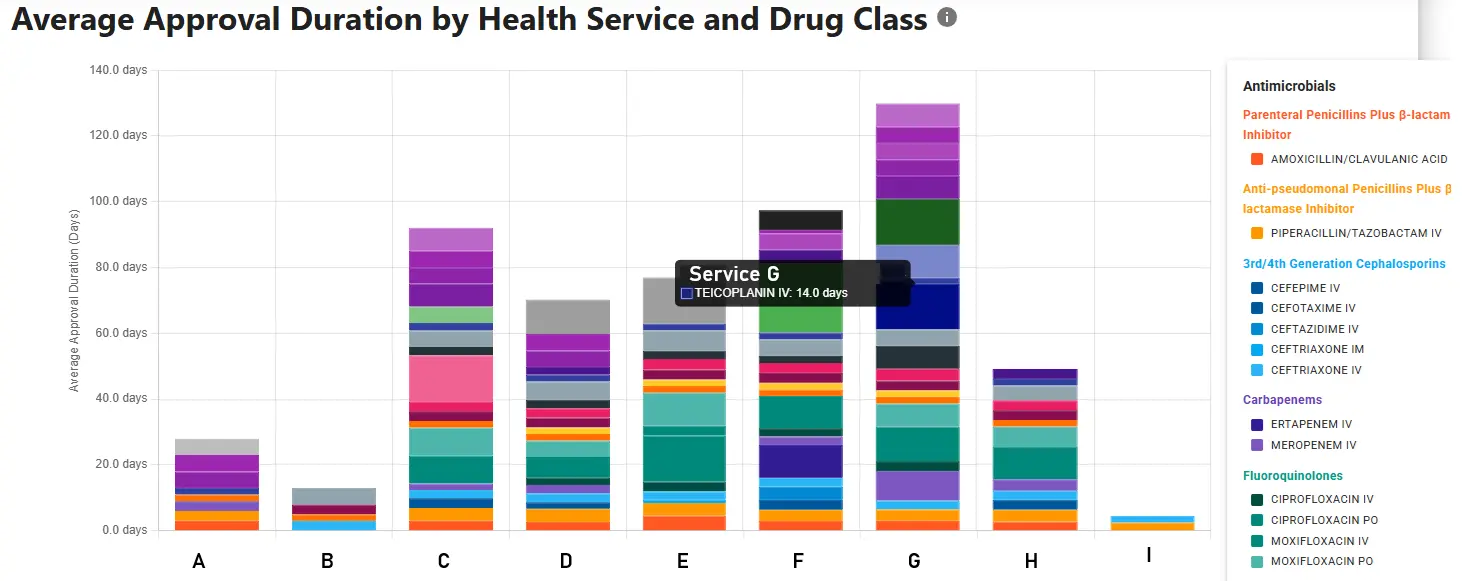
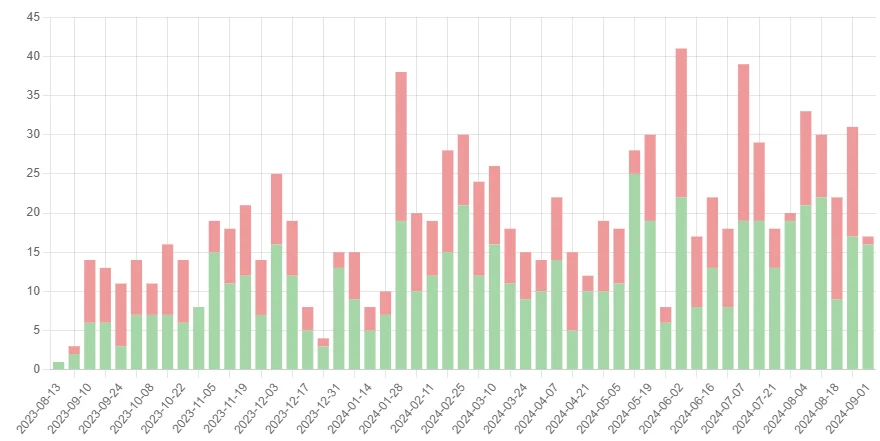
- Continuous appropriateness audit within the clinical workflow
- Every procedure change recorded with version, author and reviewer
- Access audit trail naming the network, facility, user and time
02 · WHO CHECKED IT, AND WHEN
Version-controlled clinical content
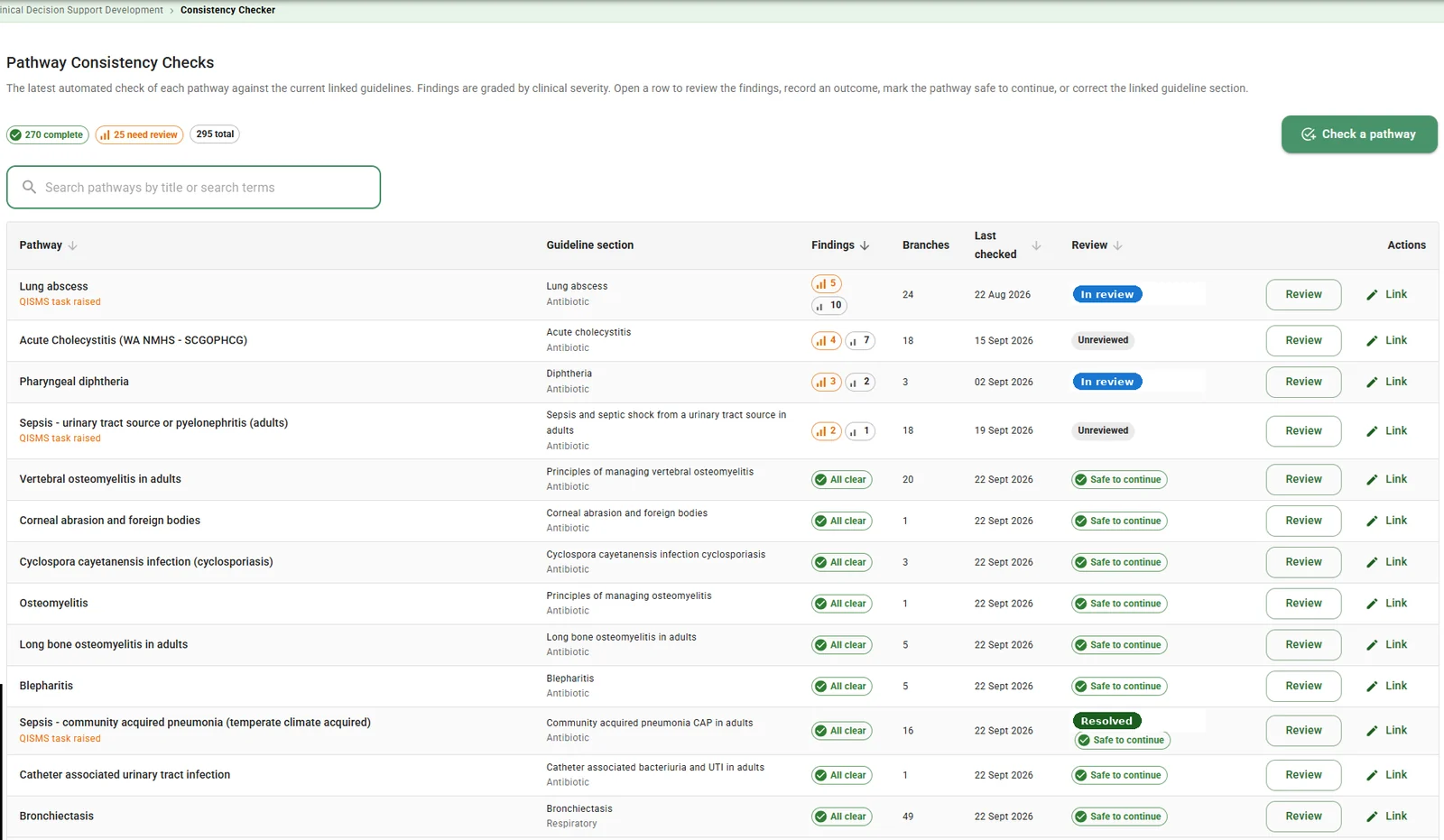
Every published pathway has a version history, and each decision records the exact version the clinician used. Every pathway is checked nightly against its linked guideline, with changes to the guideline flagged for review against the pathway recommendations. A built-in governance cycle ensures peer review and approval of all clinical content.
- Shared review panel: reviews requested, underway and completed, each with version and author
- Alerts when a source document is replaced, with content ownership maintained through staff changes
- Automated testing before release, with proactive fault detection
03 · QUALITY IMPROVEMENT AND BENCHMARKING
Benchmark each improvement cycle against peers
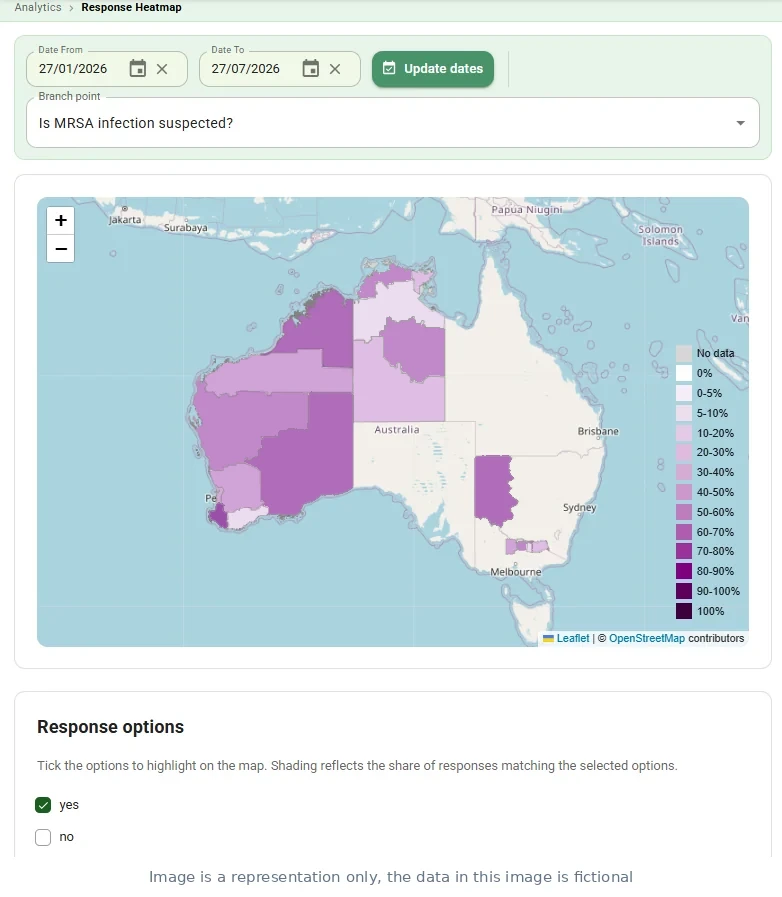
Each plan, do, study, act cycle is visible in data. Built-in KPI dashboards compare your service with peer groups, and the decision heat map shows where pathway decisions differ across your sites and from peer services, when both opt in. Living guidelines add length of stay and readmission by guideline, supporting Standard 1 variation evidence and protocol review.supporting variation evidence and protocol review.
- KPI dashboards benchmarked against peer groups, opt-in
- Decision heat map of branch responses by site and region, over any period
- Living guidelines outcomes by pathway on a dashboard, with data export
- A data collection protocol to measure outcomes within your own service
RAPID IMPLEMENTATION
Your guidelines, converted into decision support
Provide your complete set of guidelines and procedures. Clinical Branches extracts the clinical logic from every document and returns draft pathways and decision support rules for your clinicians to review.
Your guidelines and procedures
Draft content for every document, ready for review
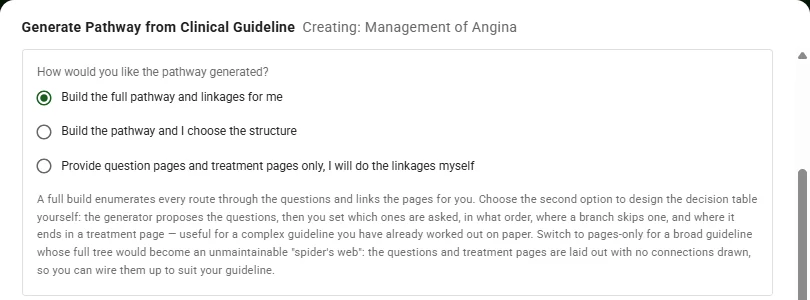
1. Share your guidelines
Provide your full set of guidelines and procedures, as they stand today.
2. Clinical logic extracted
Every document becomes a draft decision tree with its decision support rules, linked back to its source.
3. Clinician review, then publish
Your clinicians review the drafts through the shared review panel. Nothing generated reaches clinical use without review.
New or revised procedures can be converted at any time, individually or as a set, and services can also subscribe to pathways other services have already built and validated.
THE BUSINESS CASE
Supporting your business case
The business case pack sets out your obligations, the current cost of meeting them, the changes Clinical Branches delivers, and the assurances available in writing. It includes a data collection protocol so your service can measure outcomes locally.
Obligations
NSQHS actions and clinical care standards you report against.Required Organizational Practices you report against.
Current cost
Manual audits, sampled reviews and the staff time they require.
Improvements
Evidence from routine decisions, verified content and visibility of variation.
Assurances
Certifications, the post-market surveillance record and the shared responsibilities matrix.
20.8 pts
improvement in prescribing appropriateness where adopted
21.8 pts
improvement in guideline compliance where adopted
0
reportable adverse events, recalls or data breaches, since November 2022
ISO
27001 and 27017 certified, TGA Class IIb conformity assessment underway
Joint evaluation of the platform by the WA Country Health Service (WACHS) and the University of Technology Sydney (UTS), funded by the Digital Health Cooperative Research Centre (DHCRC-0248). Prescribing was compared before and after implementation in a balanced sample of three adopter and five non-adopter hospitals, and the estimates describe an effect observed where the platform was adopted. WACHS deploys the platform as AMPS. Read the evaluation snapshot (PDF). Post-market surveillance record: no reportable adverse events, TGA notifications, recalls or data breaches.
Implementation and support
A managed service with implementation, upgrades and support included.
Browser-based deployment
Runs in the browser on managed devices, with native iOS and Android apps. Single sign-on with Microsoft Entra ID is in production at multiple health services.
Live in two to six months
Environment, configuration and single sign-on in four to eight weeks, local content review alongside, then onboarding in two to four weeks per site group.
Upgrades and support included
Maintenance, security patching, releases and upgrades are included in the licence. Releases are zero-downtime with seven days notice, and support is delivered directly by the Clinical Branches team.
Predictable per-bed licensing
No per-user, per-transaction or per-query charges, so costs stay predictable as adoption grows.
Security and shared responsibilities Device information Plans and pricing
Request the business case pack
An executive summary, the standards and evidence mapping, and the security and shared responsibility documentation required for ICT review.
Explore other roles