
STAGE 01
Your procedures become pathways and rules
One document gives you the pathway a clinician walks through at the bedside and the decision support rules behind it, which read the answers given and raise a hint when therapy should change.
Build it from your own documents, subscribe to a peer service that has already done the work, or adopt platform core content and localise it. Your governance team reviews and publishes either way.
AI-Assisted Pathway and Rule Builder
Upload your guideline documents and the builder converts them into interactive pathways and the decision support hints that run off them. Review, refine and publish in minutes.
- AI converts your documents into a draft pathway
- The same document yields the decision support rules that watch the answers and prompt a therapy change
- Drag-and-drop visual editor for refinement
- Version control, with every published change recorded
- Collaborate, review and publish workflow your governance team controls

The rules behind the pathway
A guideline also says what should happen next, and under what conditions. Those conditions become decision support rules that read the pathway answers alongside the patient's recorded medication and results, and raise a hint when therapy should change.
THE RULE CANVAS
Rules are built and edited on a drag-and-drop canvas, visible to the governance team that signs them off.
- Yes/no checks on pathway answers
- Value thresholds and bands, such as renal function
- Medication group and allergy checks
- Assembled into the logic that decides when a hint fires
Build your own
Your local procedure, your formulary, your escalation rules. The pathway reflects how your service works.
Subscribe to a peer
Take a published pathway set from another service on the platform. Small sites get the work of a large one without having to reproduce it.
Platform core content
An expert-maintained library kept current with national guidance, spanning twenty five clinical streams. Adopt it as published or fork it and localise.
Twenty five clinical streams
Core content spans twenty five clinical streams: cardiovascular, respiratory, obstetric and perinatal emergencies, trauma, the older person, palliative care, pain and analgesia, diabetes, neurology, antimicrobial, toxicology and more.
Services usually start with the stream carrying the heaviest obligation and add others as the workflow beds in.
It looks like your service
Custom domain, logo and colours, so staff open something that belongs to the organisation they work for.
STAGE 02
Decisions at the bedside
A generalist, junior or locum prescriber reaches a defensible decision without a specialist on hand. On a ward round, in a corridor, at three in the morning, with or without a signal.

Interactive Clinical Pathways
Static PDF guidelines become step-by-step pathways that carry a clinician to the right decision at the point of care. Average time from opening a pathway to a recommendation is 48.1 seconds.
- Branch by branch guidance to a named endpoint
- Dosing calculated against the patient in front of you
- Deterministic and reproducible: the same answers give the same recommendation, every time
Clinical Calculator Library
Dosing, renal function and patient-specific calculators sit inside the pathway, so the number that informs the decision is the number recorded with it.
- Bayesian Vancomycin AUC TDM Calculator
- Empiric dose calculators for vancomycin and aminoglycosides
- BMI, cardiac risk, renal function and more


Offline-First Mobile App
Pathways and calculators work without a connection, because hospital network coverage is not a reasonable thing to depend on at the bedside. Shipped and in use on Android and iOS.
- Pathways work fully offline
- Built-in clinical calculators
- Approval code generation
- Records sync back when the device reconnects
Therapy change prompts
The platform reads pathway responses alongside the patient's recorded medication and flags where therapy should change: an intravenous course that could move to oral, a duration running past its endpoint, a high-risk combination. The prompt goes to the team that can act on it.
WHERE PROMPTS APPEAR
Prompts surface on the web interface, on the ward list a reviewing pharmacist or stewardship team works from. They do not interrupt a prescriber mid-decision on a phone.
Every prompt, and whether it was actioned, is counted as one of the Stage 04 measures.
Bayesian Vancomycin AUC Calculator
Free to useAUC-guided vancomycin dosing from a single measured level. Bayesian inference runs against five published population pharmacokinetic models, the right model is selected for your patient automatically.
- Targets AUC24/MIC of 400 to 600, in line with the 2020 IDSA consensus guidelines.
- Dose options from Q8H to Q48H, each with AUC24, AUC/MIC, peak and trough.
- Warnings for poor model fit, unstable renal function and levels drawn too early.
No black box
Every calculation includes a full report: which population model was used and why, and the parameter estimates behind the curve.
There is a feedback forum inside the app, so clinicians can question an output and get an answer from the people who built it.
93.4%
of predictions within 20% of the reference AUC
1
level needed, not a peak and trough pair
5
population models, chosen for you
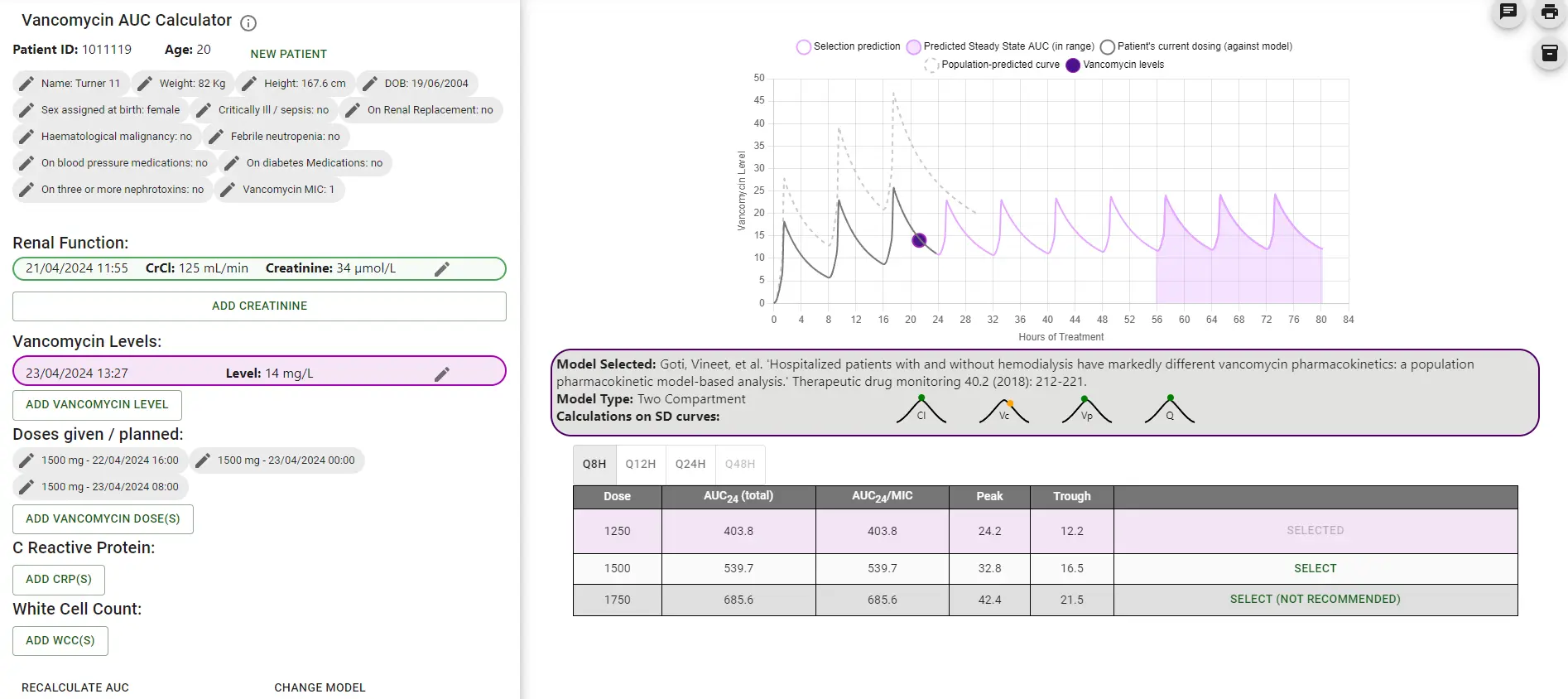
Scroll the panel sideways to explore the full calculator.
Validated across three phases against two-level Sawchuk-Zaske reference AUCs: 296 single-level estimates in phase one, then 440 predictions across 110 patients in phase two, where 93.4% of predictions fell within 20% of the reference under automatic model selection. A clinician usability round followed (n=17). TGA registration is underway.
STAGE 03
Trends tied to outcomes
Nobody fills in a second form. The record is a by-product of the decision, and the dashboards are built from it.
A record the decision writes itself
Completing a pathway produces the record. The branches taken, the endpoint reached, the pathway version in force and the recommendation given are captured as the clinician works, so the case can be reviewed later without relying on anyone's memory.
- Full breadcrumb of the route taken through the pathway
- Approvals and interventions recorded with timestamps
- The exact content version that produced the recommendation
- Export-ready reports for clinical governance and quality improvement
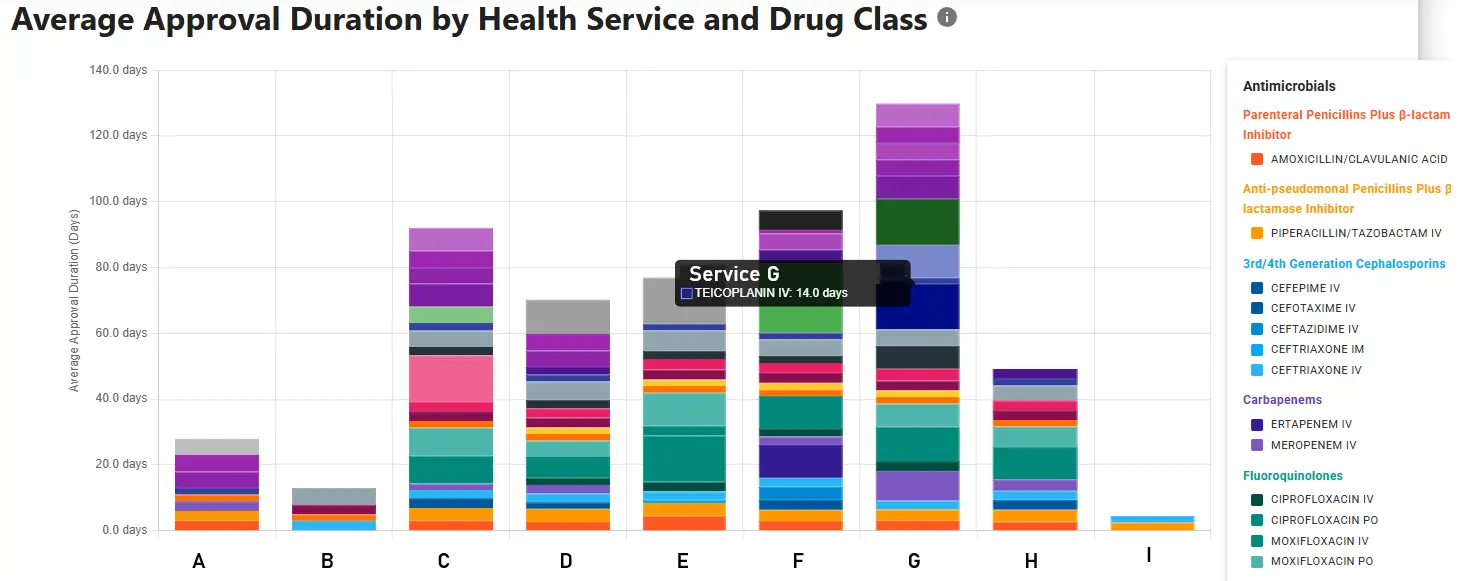
Dashboards built from that record
Dashboards are built for the streams your service runs, reading from the same record the clinicians produced.
Practice and appropriateness
How often recommendations are followed, how prescribing scores against the national appropriateness categories, and which interventions are being made.
- Recommendation uptake over time
- Appropriateness scoring, treatment and prophylaxis
- Intervention and approval analysis
Variation across your network
See where practice differs between your own sites and wards.
- Site and ward comparisons
- Outlier identification
- Opt-in comparison with peer services
Tied to patient outcomes
Where an admission feed is connected, pathway use can be charted against length of stay, readmission and intravenous to oral switch.
- Length of stay analysis
- Readmission tracking
- Intravenous against oral duration
The review list builds itself
A pharmacist with four hours and ninety patients has to choose. The platform builds a prioritised review list from therapy that needs attention: prompts raised, courses running long, high-risk combinations, patients whose pathway endpoint suggests review.
HOW THE LIST IS BUILT
From prescriptions and patients, not prescribers. Clinicians in the joint WACHS and UTS evaluation described the platform as directing attention to patients requiring review, and called it an enablement platform.
STAGE 04
Evidence and benchmarking
Accreditation evidence accrues from routine use. When an assessor asks what your service does and whether it works, the answer is already assembled.
What gets measured
Some measures the platform produces on its own. Others your service already collects, and the platform gives them something to be read against.
The platform produces these for you
- Pathway completions by pathway, team and site, including where a clinician went back before finishing
- Time from opening a pathway to reaching a recommendation
- Recommendation uptake: followed, not followed, or not recorded
- Appropriateness scored against the national categories, for treatment and for prophylaxis
- Approval codes issued, and the indications behind them
- Therapy change prompts issued, and how many were actioned
- Interventions raised, accepted or declined, by ward and by team
- Custom extracts: recommendations, approvals, interventions, pathway routes and access logs
Your service still collects these
- National appropriateness audit submissions
- Defined daily dose usage surveillance
- Staff hours released, and what they were redirected to
- Adverse events and incident reporting
With an admission feed connected
Length of stay, readmission and medication history data can flow in, and the platform charts them next to pathway use. Without a feed, these remain yours to collect and compare.
Measured at the prescription, not the prescriber
Every measure above is counted against a prescription, a pathway or a patient. Dashboards aggregate by pathway, ward, team and site.
As a regulated medical device, Clinical Branches logs user access for security and traceability, like any clinical system your service runs. That log serves incident investigation, not the quality dashboards.
Benchmarking, if you choose it
Services on the platform can compare themselves against their peers on the same measures. It is opt-in, and a service that does not want its practice visible simply does not turn it on.
Ready when the assessor is
The record answers the questions accreditation standards ask: what your procedure is, that clinicians followed it, that variation was reviewed, and that something changed as a result. It accrues continuously, so there is no scramble before a survey.
Who carries the risk when the answer is wrong?
Both of these are already live in Australian hospitals.
IF YOU ARE THE ONE PRESCRIBING
The tool takes the credit. You take the liability.
General purpose AI assistants state in their terms of use that their output is not medical advice and that the user is responsible for how it is used. They do not guarantee a correct answer, show how they reached it, or reproduce it. If it is wrong, the accountability sits with the clinician who acted on it.
A Clinical Branches recommendation is deterministic, versioned and attributable. You can see the pathway, the version and the logic that produced the answer, and so can anyone reviewing the case afterwards.
IF YOU ARE THE ONE SIGNING IT OFF
Your staff adopted AI faster than you could authorise it.
- A quarter of UK GPs use generative AI in practice. Ninety-five per cent have had no training in it. Blease C et al, Digital Health, 2025. n=1,005 UK GPs.
- AI scribe use among Australian GPs doubled in fifteen months. Healthed and The Medical Republic survey, May 2026. n=1,535 Australian GPs.
- The Commission is explicit that clinicians should use only AI tools their organisation has authorised. ACSQHC Artificial Intelligence Clinical Use Guide v1.0, August 2025.
- NSW Health and Safer Care Victoria both rule out unregulated AI for clinical use, and no AI scribe is listed on the ARTG. NSW Health IB2024_059, November 2024. Safer Care Victoria advisory, July 2023.
We took the regulated path
The same inputs give the same answer, and every answer is versioned and traceable to the content that produced it.
TGA Class IIb
Conformity assessment underway with the Therapeutic Goods Administration, with scribe functions in scope.
ISO 27001 and 27017
Current certification for information security and cloud security.
Deterministic by design
No model drift between calculations. Every recommendation reproducible and auditable.
Enterprise-Grade Security and Safety
Healthcare-approved security and quality compliance standards


ISO 27001 & 27017
International cybersecurity standards
CSA STAR Level One
Cloud security assurance
OWASP Top 10
Web vulnerability protection
Australian Privacy Act
Data protection compliance
Clinical Branches has been approved through independent cybersecurity assessments by health services across Australia and Canada. Data is encrypted in transit and at rest, security audits are conducted annually, and the platform is routinely penetration tested.
See it against your own procedure
Bring one of your own guidelines and we will build it into a pathway with you.