
For antimicrobial stewards
Antimicrobial stewardship
across every ward and site.
Guide prescribing at the point of care, prioritise patients for stewardship review, and audit appropriateness continuously.
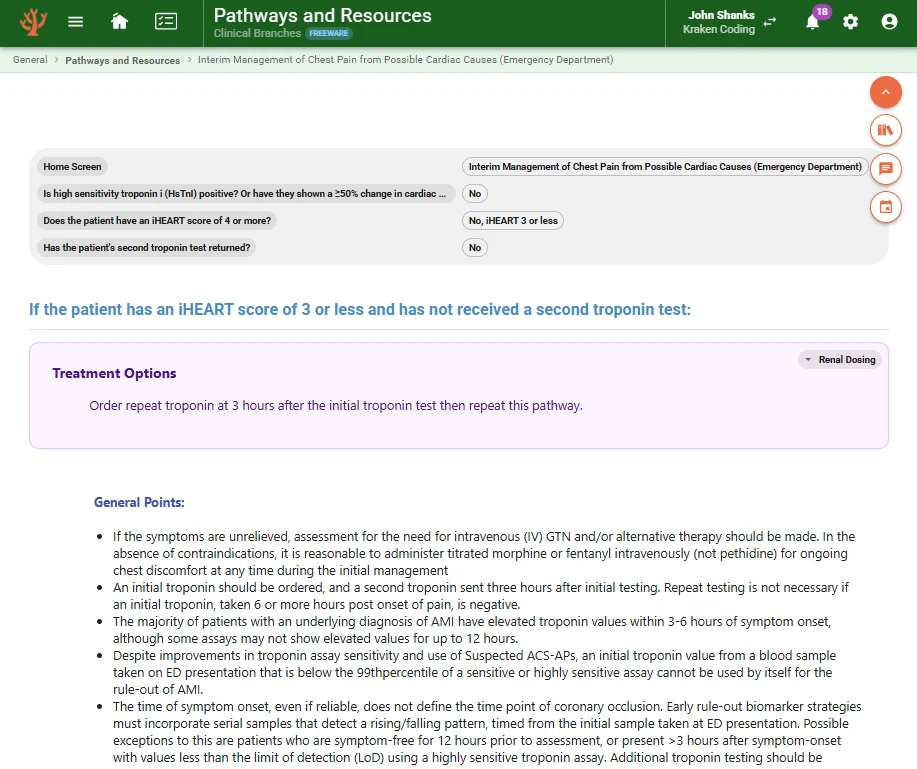
Each pathway decision guides the prescriber, ranks the stewardship list and reveals variation in practice.
The challenges
- Antimicrobials are among the most commonly prescribed high-risk medicines, and stewardship teams must choose between reviewing only patients on broad-spectrum agents and reviewing every patient on an antimicrobial.
- Reviewing only broad-spectrum agents biases advice towards narrowing therapy. Stewardship works both ways, and finding patients whose narrow-spectrum therapy needs to change or broaden builds trust with the treating teams.
- Telling appropriate from inappropriate use of narrow and broad-spectrum agents alike needs a reliable system, which is difficult to build from written notes or inconsistent EMR data.
- Education fixes a recurring issue, only for the next rotation of staff to repeat the same error.
- Teams have limited prescribing confidence, and "the consultant told me to" ends the evaluation. An incorrect regimen started in the emergency department is often carried through admission, because busy ward rounds and emergency teams do not know which regimen to use.
- Restriction systems improve prescribing reactively, one to three days after the prescription starts and post-prescription review occurs. No tool improves stewardship before prescribing.
- Without laborious audits, there is no way to see which regions or teams contribute to incorrect initial therapy.
Capabilities for stewardship programs
01 · BEFORE PRESCRIBING
Stewardship at the point of prescribing
Prescribers follow your local guidance, with the regional antibiogram and local advice built in and a specific alternative at each branch, so stewardship starts before the first dose rather than at post-prescription review days later. The emergency department and the admitting team work from the same regimen.
Every answer is recorded against the patient, giving the AMS team the reasoning behind each prescription as a breadcrumb of the decision. Where local policy allows, the approval code is issued at the end of the pathway, so routine approvals no longer need a call to the stewardship team.
In the joint WACHS and UTS evaluation of the platform before and after implementation, prescribing appropriateness improved by 20.8 points where pathways were adopted. Read the evaluation snapshot (PDF).
At nighttime when you are dealing with a deteriorating patient, being able to get onto [Clinical Branches] and figure out how to broaden cover to cover sepsis with unknown origin or something is extremely, extremely helpful.Resident medical officer, evaluation participant P09
02 · PRIORITISATION
Review every patient on an antimicrobial, in order of need
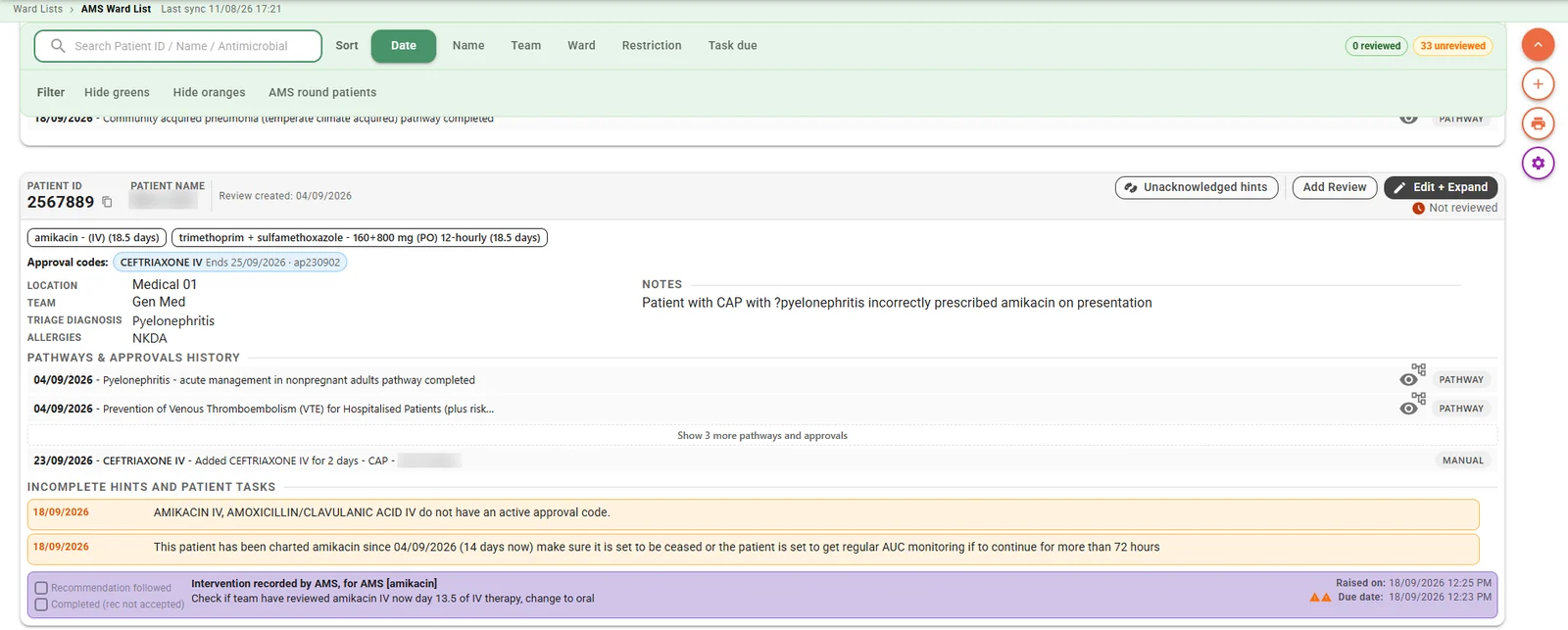
Hints screen every patient on an antimicrobial, not only those on broad-spectrum agents, so the stewardship list surfaces patients whose therapy should be broadened or changed as well as narrowed, and review starts with the patients who most need it. The AMS pharmacist subscribes to the stewardship hints their workflow needs from a shared library of thousands, and builds local rules on the hint builder canvas.
- Narrow and broad-spectrum therapy screened alike
- A shared library of thousands of hints, plus rules your team builds or adopts from other services
- Thumbs up or down ratings refine each hint over time
- In a 12-month local program reviewing every antimicrobial, recommendation uptake rose from below 45% to over 65%
03 · CONTINUOUS AUDIT AND BENCHMARKING
Continuous audit, and benchmarking with peer services
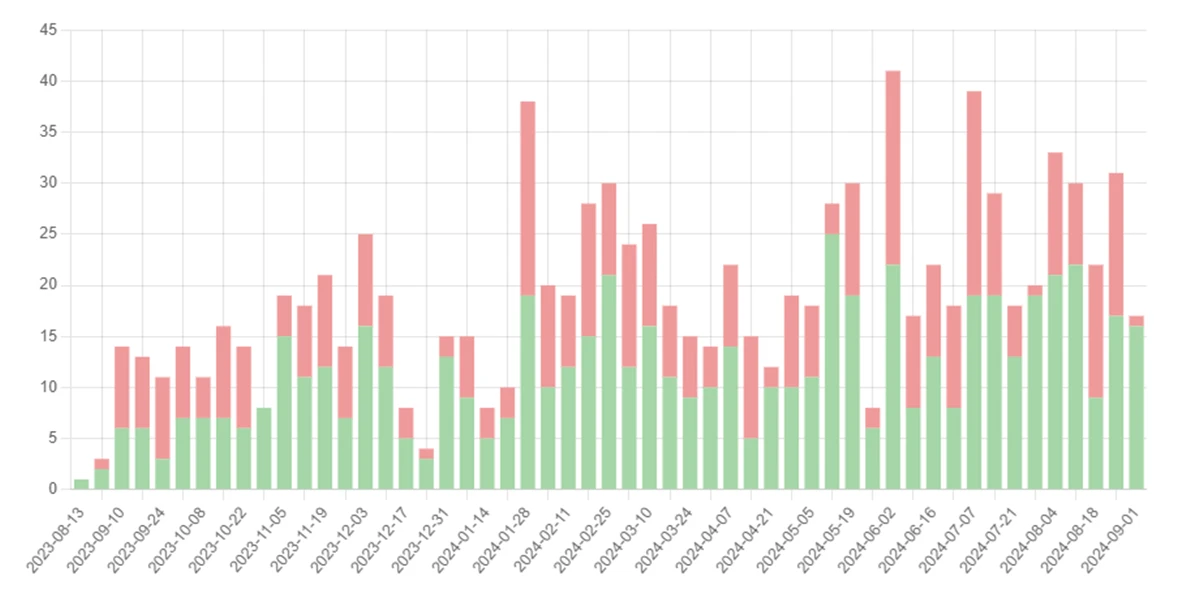
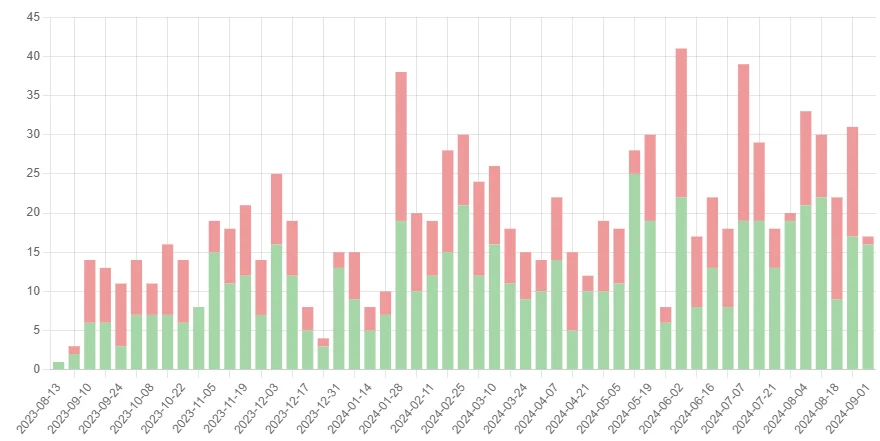
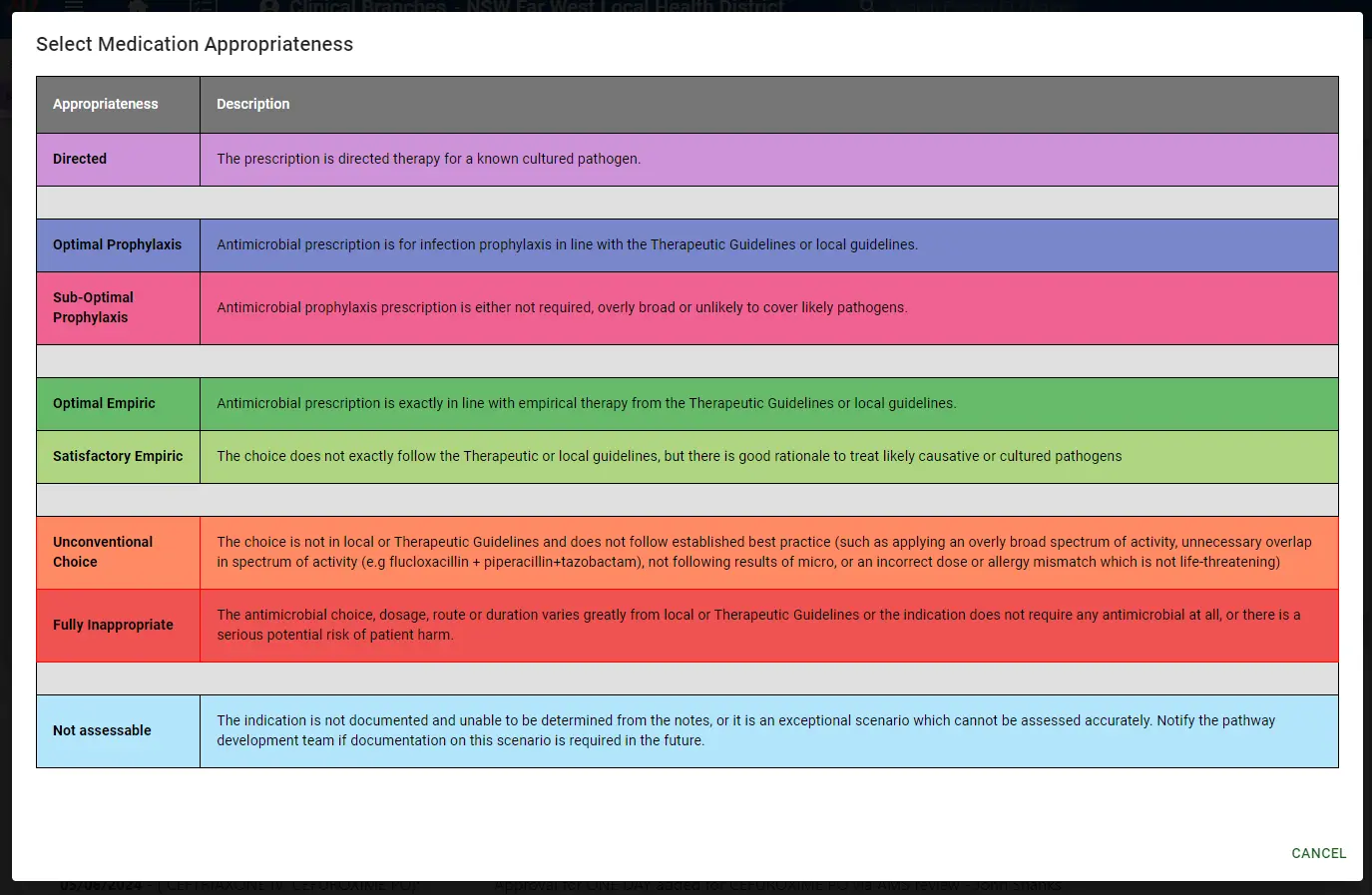
Appropriateness is recorded during review, using established categories, and reported weekly alongside recommendation uptake, IV to oral duration and variation between sites. See which regions, teams and entry points contribute to incorrect initial therapy without a laborious audit, and target education where it is needed. Services that share a benchmarking agreement can compare their results with each other. Supports NSQHS actions 3.18 and 3.19, and the audit tool is released under a Creative Commons licence.Supports the evidence requirements of the antimicrobial stewardship Required Organizational Practice.
- Benchmarking with peer services under a shared agreement
- Incorrect initial therapy traced to region, team and entry point
- Audit data remains under your service's control
04 · PRECISION DOSING
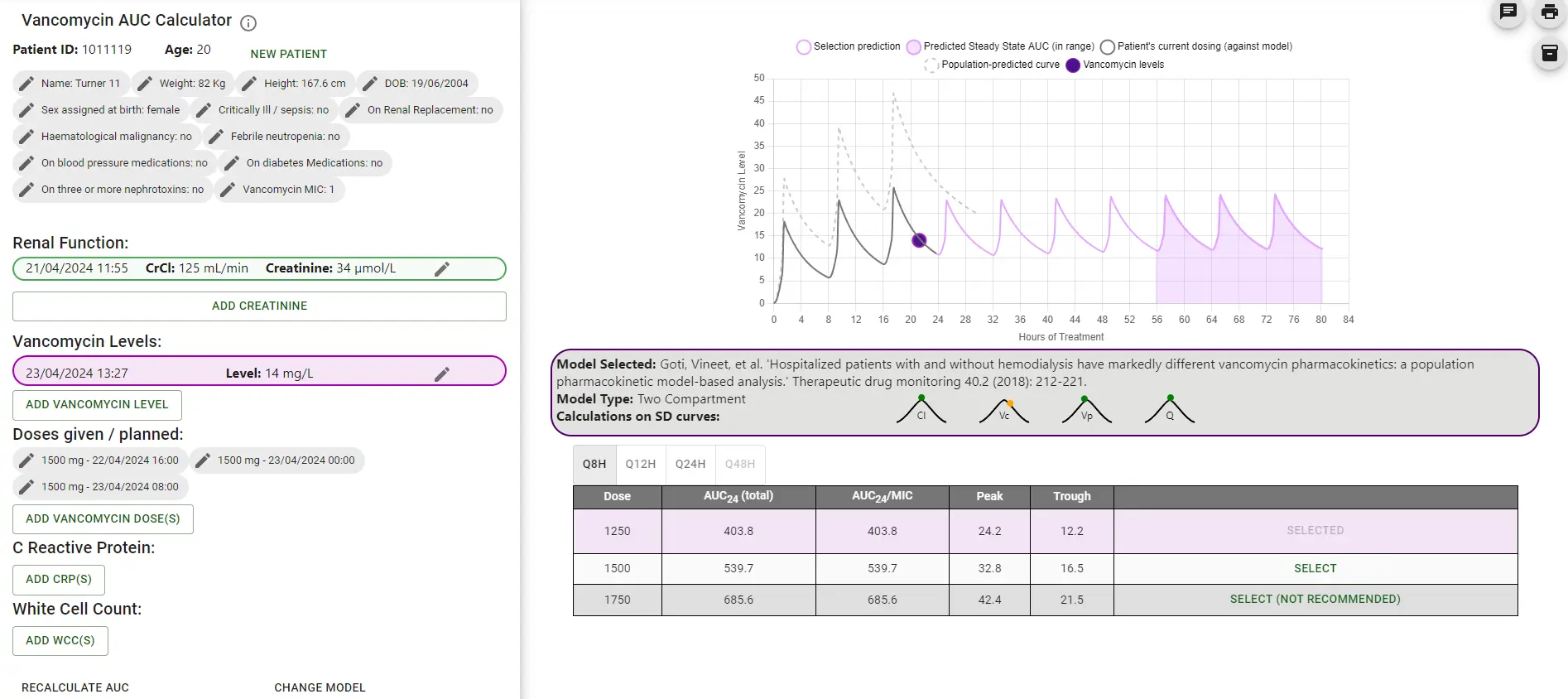
Vancomycin AUC dosing from a single level Free
Bayesian AUC dosing from a single level, with the model, predicted curve and dosing options shown in a transparent report. The calculator is validated against two patient cohort reference sets, synthetic data and clinical staff feedback, and is undergoing TGA Class IIb conformity assessment. Further AUC calculators are in the pipeline, starting with aminoglycosides. Read the validation poster (PDF).
- Included on every plan
- Predicted AUC, peak and trough for each dosing option
- Aminoglycoside AUC dosing in the pipeline
RAPID IMPLEMENTATION
Your guidelines, converted into decision support
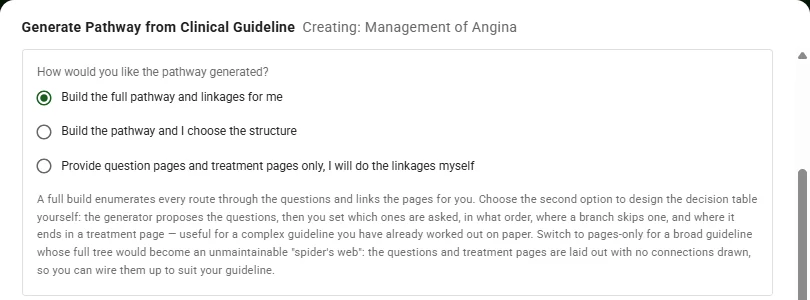
Provide your complete set of guidelines and procedures. Clinical Branches extracts the clinical logic from every document and returns draft pathways and decision support rules for your clinicians to review.
Your guidelines and procedures
Draft content for every document, ready for review
1. Share your guidelines
Provide your full set of guidelines and procedures, as they stand today.
2. Clinical logic extracted
Every document becomes a draft decision tree with its decision support rules, linked back to its source.
3. Clinician review, then publish
Your clinicians review the drafts through the shared review panel. Nothing generated reaches clinical use without review.
New or revised procedures can be converted at any time, individually or as a set, and services can also subscribe to pathways other services have already built and validated.
Additional stewardship capabilities
Restricted antimicrobial approvals
Restriction prompts and an approval list governed by your local policy.
Approval duration reporting
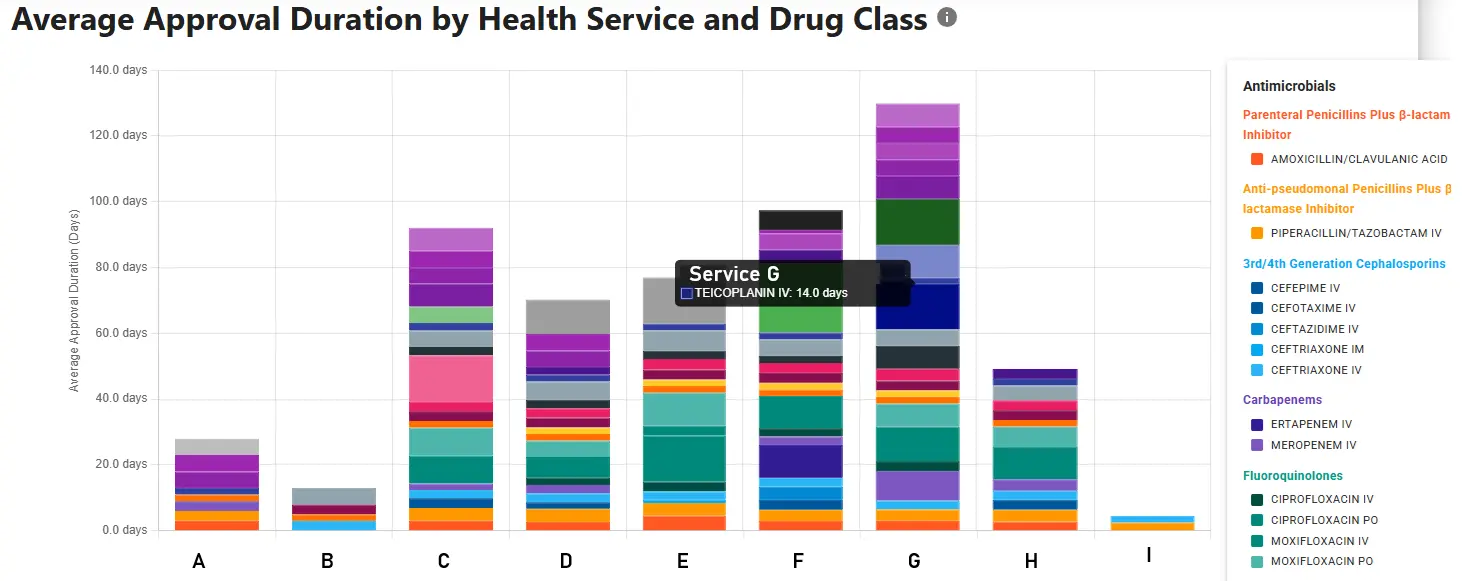
Average approval duration by health service and drug class.
Recommendation uptake
Uptake of stewardship recommendations reported by team and site.
Hint usefulness reporting
Usefulness measured for each hint, to inform which hints remain enabled.
Variation heat map
Frequency of each branch response by region, over any period.
Shared review panel
Reviews requested, underway and completed, each with version and author.
Benchmarking agreements
Compare stewardship measures with peer services under a shared benchmarking agreement.
EMR integration
Operates alongside Epic, Cerner and MedChart, or independently.
20.8 pts
improvement in prescribing appropriateness where adopted
21.8 pts
improvement in guideline compliance where adopted
28 to 68%
optimal prescribing at the WACHS Emergency Telehealth Service, local audit
84%
of 2,214 hints rated useful over 12 months, local evaluation
4 + 12
Canadian hospitals live, and in implementation
77
hospitals live across Australia and Canada
Joint evaluation of the platform by the WA Country Health Service (WACHS) and the University of Technology Sydney (UTS), funded by the Digital Health Cooperative Research Centre (DHCRC-0248). Prescribing was compared before and after implementation in a balanced sample of three adopter and five non-adopter hospitals, and the estimates describe an effect observed where the platform was adopted. WACHS deploys the platform as AMPS. Read the evaluation snapshot (PDF). The WACHS Emergency Telehealth Service figure is a local audit. The hint figure comes from a 12-month virtual stewardship programme at Far West Local Health District that reviewed every patient on an antimicrobial, presented at the SHPA Medicines Management conference. It is a local audit, not an independent evaluation. RAPA, named in the poster, is the audit tool within Clinical Branches. Read the conference poster (PDF).
What clinicians say
Evaluation participants are anonymised by the study.
I just use it for everything. Being in my 41st year of practice, I forget things far more than I did when I was younger. And also antibiotic guidelines change all the time, so I don't trust that what I did yesterday is the same as today's recommendations.
[Clinical Branches] is targeted against you making a right antibiotic choice, and it cuts down on a lot of the extra waffle around that.
I have worked with John for three years developing and refining an electronic web-page based antibiotic approval system for the general hospital I work for. The process has been stress free, professional and the end product has been excellent.
Clinical Branches gives us line of sight into which patients need us most. It helps us deliver smarter care, not just more care.
Implementation and support
A managed service with implementation, upgrades and support included.
Browser-based deployment
Runs in the browser on managed devices, with native iOS and Android apps. Single sign-on with Microsoft Entra ID is in production at multiple health services.
Live in two to six months
Environment, configuration and single sign-on in four to eight weeks, local content review alongside, then onboarding in two to four weeks per site group.
Upgrades and support included
Maintenance, security patching, releases and upgrades are included in the licence. Releases are zero-downtime with seven days notice, and support is delivered directly by the Clinical Branches team.
Predictable per-bed licensing
No per-user, per-transaction or per-query charges, so costs stay predictable as adoption grows.
Clinical Branches can operate alongside an existing Guidance AMS deployment.
Security and shared responsibilities Device information Plans and pricing
Book a demonstration
See how Clinical Branches supports your stewardship program, configured against your local guidance and antibiogram.
Explore other roles